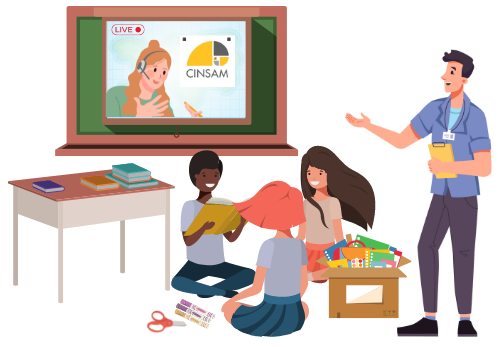
Join CINSAM virtually for FREE, fun, hands-on STEM activities that you can do in the classroom or right at home! We'll Zoom in live to your learning space and guide you and your student(s) through engaging, educational lessons. STEM2U lessons are targeted to elementary and middle school grades.
Before every lesson, you'll be equipped with:
Your students get a fun change of pace that helps lock in the lesson...
and YOU get to add some tried-and-true teaching activities to your toolbox. WIN-WIN!


Download or print the Spring 2026 Schedule & Lesson Details (PDF).
This schedule is subject to change. Please check back regularly for updates.
Subject: Earth & Space Science | Topic: Earth's Place in the Universe
Stars are so much more than bright dots in the sky. Together, we will learn how patterns in the stars were used long ago and how we still use them today. Students will learn which constellations are visible all year and at different times throughout the year. Then we’ll let our creativity combust as we dive into the art of Constellation Creations. We’ll make and learn how to use a Constellation Wheel, and students will choose their favorite constellation to design a hanging decoration.
More
Materials Needed (per student):
Standards Connection:
Subject: Physical Science | Topic: Light
Valentine's is a time for secret sweet science messages! Students create secret colored messages that can only be revealed using a very special magnifying glass. As students reveal their secret messages, we will learn how different colored inks absorb and reflect different wavelengths (colors) of light.
More
Materials Needed (per student):
Standards Connection:
Subject: Physical Science | Topic: Circuits
What happens when Play-Doh meets an electrical current? It’s time to power up playtime as students discover they can build real working circuits using Play-Doh. After seeing this electric action, students will make homemade play-doh to test in place of the brand-name Play-Doh. Through scientific play, students will investigate circuits, conductivity, and insulators. They will conduct additional tests to figure out how to turn an insulator into a conductor.
More
Materials Needed:
Ingredients to Make Insulated Doh:
Standards Connection:
Subject: Engineering Design | Topic: Engineering
Build it. Spin it. Test it. Fidget Spinning Science puts a hands-on twist on physics! Students will explore the science behind fidget spinners by designing, building, and testing two different spinner models using everyday materials. As they experiment with balanced and unbalanced forces, weight, and motion, students will investigate how design elements affect spin time. Which design will spin the longest? There’s only one way to find out – test it like a real engineer!
More
Materials Needed
Standards Connection
Subject: Engineering Design | Topic: Engineering
Student teams will work together to test and compare materials best suited for each part of a bandage. This includes testing for stickiness and water absorption. They will use their data to create two new types of bandages by combining the best materials. Students will learn about a possible new technology that could be added to bandages to build a better bandage for trauma situations. Then they will be challenged to use their own two designs to test this new technology and compare the results to the two bandages they originally selected without the technology.
More
Materials Needed (per group):
Standards Connection:
Subject: Earth Science | Topic: Natural Hazards
Students come together to create solutions to help the Carter family with a huge flooding issue. As much as they love their house next to the beautiful river, last year, flash flooding caused their home to flood twice! It caused major damage to carpets, floors, and walls. Although everything has been repaired, the Carter family needs help to find a solution to instantly stop flood waters from ruining their house again. Students are challenged to design a device, using what they have learned about water-absorbing crystals, to stop flood waters from entering the Carter Family Home.
More
Materials Needed:
Standards Connection:

Topic: Coding
How do computers talk to one another? They transmit information through a code of 0s and 1s called binary. Students will learn about binary code and will create a bracelet of their initials in binary made out of beads.
Request access to 'Binary Bracelets'.
More
Materials Needed:
Topic: Coding
Students will work to demonstrate their skills on the greatest cup stacking challenge while adhering to the criteria and constraints given to them. They will also dive into beginner-level unplugged coding!
Request access to 'Coding With Cups'.
More
Materials Needed (per student or group):
Standards Connection:
Topic: Coding
Ready for an Escape Room challenge? Students will use logic and reasoning to find clues to unlock the State of Matter digital breakout puzzle.
Request access to 'Digital Breakout'.
More
Materials Needed:
Topic: Coding
In this hands-on STEM lesson, students will discover the fascinating connection between traditional weaving looms and coding principles. They will construct their own looms and explore how patterns in weaving resemble the algorithms and sequences used in computer programming. By weaving their first project, students will combine creativity with problem-solving while deepening their understanding of technology and history.
Request access to 'Looms and Coding'.
More
Materials Needed (per group):
Standards Connection:
Topic: Earth's Systems
Learn about the importance of the Earth’s most precious resource - water! Students will see first-hand how little fresh water there is on Earth and how to create their own filtration system to help clean it.
Request access to 'Cleaning Earth's Water'.
More
Materials Needed:
Standards Connection:
Topic: Earth's Place in the Universe
Students will learn about impact craters as they create their own and measure the destruction caused by them. They will test various sized meteors and compare their impact. Students will also create variable situations for meteors and record data on the impact of those variables.
Request access to 'Creating Craters'.
More
Materials Needed:
Standards Connection:
Topic: Natural Hazards
Students will work in teams to discover and build structures that demonstrate how engineers construct buildings to survive powerful forces such as earthquakes.
Request access to 'Earthquake Structures'.
More
Materials Needed:
Per class:
Per group:
Standards Connection:
Topic: Erosion
In this lesson, students get hands-on with the gritty details of how rocks tumble in a river. They'll be tearing up construction paper, playing the role of a river, and figuring out why beaches end up covered in sand. It's not your typical class—it's more like a rock 'n' roll investigation!
Request access to 'Erosion: Nature's Creative Canvas'.
More
Materials Needed (per group of 3-4 students):
Standards Connection:
Topic: The Role of Water in Earth's Processes
Water is everywhere and it is our planet’s most valuable resource. Students will learn just how little available water humans have and the importance of keeping it clean when they are presented with an issue of our city’s water being contaminated. They will have to work together to learn ways our water could become contaminated, how we can prevent it from happening and most importantly, how to clean the sample they have been given of the contaminated water.
*This is lesson 1 of 2 of a mini water pollution unit. Classes are encouraged to join us for both weeks, but it is required.
Request access to 'Filtration Investigation'.
More
Materials Needed (per group):
*Teacher preparation tips:
Standards Connection:
Topic: Human Impact on Earth Systems
Bring the environment into your classroom as students create and investigate models of the greenhouse effect and compare them to our atmosphere.
Request access to 'Greenhouse Effect'.
More
Materials Needed:
Per group:
Standards Connection:
Topic: Earth's Place in the Universe
Do you have what it takes to land a rocket on the moon or another planet? Students will build their straw rockets and then investigate the effect of different angles on the trajectory of their rockets. This lesson has a great connection to elementary measurement and geometry standards.
Request access to 'Landing on the Moon and Planets'.
More
Materials Needed:
Per student:
Per group of 3 to 6 students:
Standards Connection:
Topic: Earth's Place in the Universe
Designing a device to land on the moon is a tough challenge, but can your students also account for the thrust a design needs to have a safe lunar landing?
Request access to 'Lunar Lander'.
More
Materials Needed:
Standards Connection:
Topic: Human Impact on Earth Systems
Students will design a device to grab ocean pollution from the water.
Request access to 'Ocean Pollution Grabber'.
More
Materials Needed:
Standards Connection:
Topic: Structure and Function
Students will explore seed germination by testing different materials, such as soil, cotton, or paper towels, to determine which supports growth best. They can also experiment with a variety of seed types to compare germination rates or combine both approaches for a more in-depth investigation. This hands-on project fosters curiosity and critical thinking while teaching fundamental concepts of plant biology and experimental design.
Request access to 'Paper Plate Greenhouse'.
More
Materials Needed (per student or group):
Standards Connection:
Topic: Rock Cycle
Let’s get rockin’ with hands-on learning about types of rocks, and weathering and erosion!
Request access to 'Rock n' Roll'.
More
Materials Needed:
Standards Connection:
Topic: Earth's Place in the Universe
Students will design a working model to demonstrate how Earth rotates and revolves in the solar system.
Request access to 'Rotation and Revolution'.
More
Materials Needed (per group):
Standards Connection:
Topic: Engineering
Students will first learn about the Apollo moon missions and their landing sites. Then, students will be challenged to design, build, and test a contraption that can deposit a moon rover into the middle of the Apollo Impact Crater.
Request access to 'Rover Retrieval'.
More
Materials Needed (per group):
Standards Connection:
Topic: Earth's Place in the Universe
While space travel is growing, humans must find a way to live safely on other planets without risking harmful exposure to UV rays. Students will explore designs to keep space travelers safe from direct UV rays.
Request access to 'Space Shelters'.
More
Materials Needed:
Standards Connection:
Topic: Seasons
Students will learn about the importance and cause of the autumnal equinox. They will then build their own sundial and explore how it works.
More
Materials Needed:
Topic: Natural Hazards
Students will design and build a volcano focusing on the physical and chemical changes that occur within the volcano during an eruption.
Request access to 'Volcanoes'.
More
Materials Needed (per group):
Standards Connection:
Topic: Energy
For thousands of years, humans have been harnessing the power of water. In this lesson, students will learn how water is used to create electricity, then design and test their own water wheel.
Request access to 'Water Wheels'.
More
Materials Needed (per student or group):
Standards Connection:
Topic: Earth's Place in the Universe
Students will be challenged to construct a model of the James Webb Telescope and then design a way to pack it and deploy it using only string and tape.
Request access to 'Webb's Telescope'.
More
Materials Needed (per group):
Standards Connection:
Topic: Natural Resources
Students will learn about alternative energy sources as they design and build working wind turbines. Students will test various structures within their turbines to create the most effective design.
Request access to 'Wind Turbines'.
More
Materials Needed:
Standards Connection:
Topic: Engineering
Introduce students to the Engineering Design Process with this engaging lesson. Students create a name tag with specific criteria and constraints, including a movable part, a shape/design that represents an interest of the student, the ability to hold a pencil, and so much more!
Request access to 'Back to School Design Challenge: Name Tags'.
More
Materials Needed:
Standards Connection:
Topic: Engineering
Students will explore balanced and unbalanced forces while they create balloon-powered cars. Students will get to experience Newton’s third law firsthand as they work to get their car to move.
Request access to 'Balloon Car'.
More
Materials Needed:
Standards Connection:
Topic: Engineering
Students explore how wildlife crossings can promote safety for both animals and humans. They will design and construct a model bridge that provides a safe path for animals to cross busy areas, considering real-world challenges like durability and habitat needs. Through hands-on problem-solving, students will develop critical thinking and engineering skills while learning about conservation and environmental stewardship.
Request access to 'Bridge to Safety'.
More
Materials Needed (per group):
Standards Connection:
Topic: Engineering
Students will take their tower-building skills to new heights with this challenge. Not only will they construct towers with limited materials, but they will have the added challenge of supporting a load-bearing bucket!
Request access to 'Bucket Tower Challenge'.
More
Materials Needed (per group):
Standards Connection:
Topic: System and System Models
Learn about the importance of the Earth’s most precious resource - water! Students will see first-hand how little fresh water there is on Earth and how to create their own filtration system to help clean it.
Request access to 'Cleaning Earth's Water'.
More
Materials Needed:
Standards Connection:
Topic: Engineering
Students will work in teams to discover and build structures that demonstrate how engineers construct buildings to survive powerful forces such as earthquakes.
Request access to 'Earthquake Structures'.
More
Materials Needed:
Per class:
Per group:
Standards Connection:
Topic: Engineering
Celebrate Pi Day with a creative engineering twist! Instead of just eating pies, students will design and construct their own pies using provided materials. Next, they'll rise to the challenge of building a freestanding structure as tall as possible to support their pie on top, without attaching it to the structure. This activity encourages creativity, problem-solving, and teamwork while exploring concepts like balance, stability, and design.
Request access to 'Hold the Pie Challenge'.
More
Materials Needed (per student or group):
Pie materials:
Structure materials:
Standards Connection:
Topic: Engineering
Think back to a fun visit you’ve had to the zoo, or seeing zoo animals do funny things on videos. Now, picture everything that surrounds the zoo animal you are thinking about. A zoo isn’t a place for entertaining community members as they walk around and look at animal exhibits. It is also a home to those wild animals, and it needs careful planning and construction for the health and safety of the animals. Join us for a two-part lesson as students become zoo engineers and plan and develop a zoo from the planning and blueprint stages on Day 1, to building an animal exhibit on Day 2.
Day 2: Groups will choose one zoo animal from their blueprints and design and build a model of a zoo exhibit for them. (Day 1 information can be found in the Mathematics section.)
Request access to 'It's Getting Wild in this Zoo (Day 2)'.
More
Materials Needed:
Building materials may vary depending on the animal students choose to design an exhibit for. These materials are suggestions, and other materials may be included.
Standards Connection:
Topic: Engineering
Feeling lucky enough to catch a leprechaun? Join us as we put engineering to the ultimate test when we design traps to catch the sneaky little leprechauns.
Request access to 'Leprechaun Traps'.
More
Materials Needed:
Standards Connection:
Topic: Engineering
Designing a device to land on the moon is a tough challenge, but can your students also account for the thrust a design needs to have a safe lunar landing?
Request access to 'Lunar Lander'.
More
Materials Needed:
Standards Connection:
Topic: Engineering
Students will design, build, and test their own solar ovens to see if they can get the temperature inside to be warm enough to melt candy like peeps or chocolate.
Request access to 'Melting Peeps with Solar Ovens'.
More
Materials Needed (per group):
Standards Connection:
Topic: Engineering
Students learn science from literature as we read Papa’s Mechanical Fish and discuss the importance of failures in engineering. As we dive into submarine science, students will apply the concepts of buoyancy and density to this underwater engineering challenge. Using the idea of biomimicry, students will be challenged to design and build a working submarine. As scientists and engineers, we constantly turn to the world around us for solutions to our problems. In this lesson, students will research features of different ocean animals that allow them to successfully navigate the water. Groups will use the features they learn about to design and build the ultimate submarine.
Request access to 'Papa's Mechanical Fish'.
More
Materials Needed (per student):
Standards Connection:
Topic: Engineering
Students will observe first-hand what happens to energy when objects collide on their pinball prototypes. We will use evidence from our observations to answer questions regarding the relationship of the speed of an object and its energy.
Request access to 'Pinball Machine'.
More
Materials Needed:
Topic: Engineering
Who doesn’t love pumpkin chunking? Students will design, build, and test their own pumpkin catapults using basic materials and little candy corn pumpkins.
Request access to 'Pumpkin Chunking'.
More
Materials Needed:
Topic: Human Impact on Earth Systems
Let’s get ready to celebrate Earth Day by upcycling various plastic containers to give them a new purpose. Get ready to be impressed with students' wonderful ideas for keeping plastics out of oceans and landfills.
Request access to 'Reinventing Rubbish'.
More
Materials Needed:
Standards Connection:
Topic: Engineering
Many different robots are built from models designed after humans and/or things in nature; robotic arms are no different. For a robotic hand to work just as well as a human hand, it needs to function exactly like the bones, muscles, and tendons of a human hand do.
With robots becoming increasingly popular, even the North Pole is recruiting robotic help this winter! After learning about the anatomy of a hand, students will design and build a robotic hand. Each robotic hand will face a challenge from the North Pole to move a set of presents to a designated location.
Request access to 'Robotic Hand'.
More
Materials Needed:
Standards Connection:
Topic: Influence of Science, Engineering and Technology on the Natural World
Companies like SpaceX and Blue Origin have been trying to make spaceflight cheaper. They just designed reusable rocket boosters to accomplish their goals, but they need a team of engineers to help them recover the rocket boosters after a spacecraft's launch.
A rocket booster burning up in the atmosphere or crashing down on Earth is no longer acceptable. Engineers at their companies have been left spaced-out with how to recover the rocket boosters gently so they don’t get damaged and can be reused.
Your team has been hired to design, build, and test a rocket-catching device while following the Engineering Design Process. Our aerodynamics student engineers must carefully consider a range of STEM concepts, like energy and force, to successfully catch their rocket standing up.
Request access to 'Rocket Boosters'.
More
Materials Needed:
Rocket Booster:
Rocket Booster Catcher:
Standards Connection:
Topic: Engineering
While space travel is growing, humans must find a way to live safely on other planets without risking harmful exposure to UV rays. Students will explore designs to keep space travelers safe from direct UV rays.
Request access to 'Space Shelters'.
More
Materials Needed:
Standards Connection:
Topic: Engineering
Students will focus on the strength of triangles in engineering to construct a toothpick bridge that can withstand the most weight.
Request access to 'Toothpick Bridge'.
More
Materials Needed (per group):
Standards Connection:
Topic: Influence of Science, Engineering and Technology on the Natural World
Students will dive into the world of 3D printing without ever touching a 3D printer. This tech-free lesson teaches students the fundamentals of 3D printing and additive manufacturing as they create their own 3D model of an object.
Request access to 'Unplugged 3D Printing Adventure'.
More
Materials Needed:
Standards Connection:
Topic: Influence of Science, Engineering and Technology on the Natural World
Students will learn about the connection between structure and function of external parts when they become biomedical engineers that design prosthetic limbs for injured sea creatures.
Request access to 'Wild Wellness Wonders'.
More
Materials Needed:
Standards Connection:
Topic: Ecosystems
Students will discover how animals change the land over time and the impact it causes as they design, build and test beaver dams.
Request access to 'Beaver Dams'.
More
Materials Needed:
Standards Connection:
Topic: Structure and Function
The perfect interdisciplinary lesson to get students intrigued about animal adaptations. Students have the opportunity to make sense of the data they collect by analyzing it in charts and graphs. This lesson is a great integration of science and math!
Request access to 'Bird Beak Data Buffet'.
More
Materials Needed:
Per group:
Per student:
Standards Connection:
Math Connection:
Topic: Structure and Function
Students will be introduced to the history behind the Macy’s Thanksgiving Day parade with Balloons Over Broadway: The True Story of the Puppeteer of Macy’s Parade by Melissa Sweet. Students will then design and build a never-before-seen creature, demonstrating how its external structures help it survive, while using criteria and constraints. Bonus challenge included.
Request access to 'Enchanted Creature Parade'.
More
Materials Needed (per student):
Standards Connection:
Topic: Structure and Function
Students will design and build a hand pollinator using selected materials. The pollinators will compete to see which one can carry the most “pollen” to a flower.
Request access to 'Hand Pollinators'.
More
Materials Needed (per student):
Standards Connection:
Topic: Structure and Function
What better way to celebrate Valentine’s Day than learning about the heart! In addition, students will conduct an experiment to investigate how movement affects their heart rate.
Request Access to 'Heart Rate Revelations'.
More
Materials Needed:
Standards Connection:
Topic: Structure and Function
Many different robots are built from models designed after humans and/or things in nature; robotic arms are no different. For a robotic hand to work just as well as a human hand, it needs to function exactly like the bones, muscles, and tendons of a human hand do.
With robots becoming increasingly popular, even the North Pole is recruiting robotic help this winter! After learning about the anatomy of a hand, students will design and build a robotic hand. Each robotic hand will face a challenge from the North Pole to move a set of presents to a designated location.
Request access to 'Robotic Hand'.
More
Materials Needed:
Standards Connection:
Topic: Structure and Function
Become a seed today and discover all the ways you travel! Students will design and engineer different models demonstrating how a seed is dispersed in nature.
Request access to 'The Traveling Seed'.
More
Materials Needed:
Standards Connection:
Topic: Light and Sound
Students will dive in to learn how light waves team up with the human eye. Students will build their model of an eye to investigate how light affects our vision.
Request access to 'Vision Voyage'.
More
Materials Needed (per student):
Standards Connection:
Topic: Ecosystems - Energy
We know trees produce the oxygen that we breathe but what kinds of trees produce the most oxygen? Students will conduct a scientific experiment to determine which trees are best to plant to produce the most oxygen in the atmosphere.
Request access to 'Who Makes the Most Oxygen?'.
More
Materials Needed (per group):
Standards Connection:
Topic: Area and Perimeter
Think back to a fun visit you’ve had to the zoo, or seeing zoo animals do funny things on videos. Now, picture everything that surrounds the zoo animal you are thinking about. A zoo isn’t a place for entertaining community members as they walk around and look at animal exhibits. It is also a home to those wild animals, and it needs careful planning and construction for the health and safety of the animals. Join us for a two-part lesson as students become zoo engineers and plan and develop a zoo from the planning and blueprint stages on Day 1, to building an animal exhibit on Day 2.
Day 1: Students use the criteria of area and perimeter to design a zoo that will include the most animals possible while ensuring they have enough space in their exhibits. (Day 2 information can be found in the Engineering section.)
Request access to 'It's Getting Wild in this Zoo (Day 1)'.
More
Materials Needed:
Standards Connection:
Topic: Newton's Laws
Students will explore balanced and unbalanced forces while they create balloon-powered cars. Students will get to experience Newton’s third law firsthand as they work to get their car to move.
Request access to 'Balloon Car'.
More
Materials Needed:
Standards Connection:
Topic: Chemistry
Let’s get popping! Things will get a little slippery as students learn about solutions and polymers while creating their own Bubble Juice.
Each team of students will compete by choosing the best ingredients for Bubble Juice Company to use in their newest Bubble Juice. After testing the company’s current Bubble Juice as a baseline, each team will work to design its own Bubble Juice recipe. Careful consideration must be given to variables as students investigate.
Students will test their solutions by blowing a bubble until it pops. Groups will measure and record the diameter of each popped bubble to determine which Bubble Juice Solution is the best.
Request Access to 'Bubble Juice'.
More
Materials Needed (per group):
Each team of students will need a flat, smooth surface to test their bubble solutions. The solution will go directly on the surface (this will get “science messy”).
Standards Connection:
Topic: Matter - Chemical Reactions
Unsure of what to do with all that extra Halloween candy? Donate it to science while learning about physical and chemical changes.
Request access to 'Candy Chemistry'.
More
Materials Needed:
Topic: Potential and Kinetic Energy
Students will design and build working parachute candy droppers that will drop candy to children.
Request access to 'Candy Droppers'.
More
Materials Needed (per group or student):
Standards Connection:
Topic: Matter - Properties of Matter
Dive into biochemistry with this chromatography challenge! Students will learn to use chromatography to separate colors.
Request access to 'Chromatography'.
More
Materials Needed:
Topic: Types of Interactions - Gravitational Pull
Join us for an engaging and challenging lesson where students experiment with variables to get the perfect shot.
Request access to 'Dunk Dynamics'.
More
Materials Needed (per student):
Standards Connection:
Topic: Magnets
Students will design a tractor, pulled by magnets, that will allow Farmer Norse to overcome the harvest challenges he has faced this year and end his farming year successfully.
Request access to 'Farmer's Harvest'.
More
Materials Needed:
Per group:
Standards Connection:
Topic: Forces and Motion
Aerodynamics will help you take flight in this lesson when you apply the concepts of drag, thrust, lift, and gravity to your paper airplane designs. Can you build an airplane that will fly the farthest?
Request access to 'Flying Into A Problem'.
More
Materials Needed:
Topic: Energy
Students explore the law of conservation of energy – that energy can neither be created nor destroyed, but can be converted! In this lesson, students will use weighted rubber bands inside cylinders to demonstrate kinetic and potential energy.
Request access to 'From Rest to Roam'.
More
Materials Needed (per student or group):
Standards Connection:
Topic: Properties of Matter
Everything is frosty outside but can you make frost inside? Students will be engaged in testing variables to create frost on the outside of cans.
More
Materials Needed:
Standards Connection:
Topic: Energy
What’s better than Putt-Putt? SCIENCE and PUTT-PUTT! Students will be challenged to design and build a putt-putt hole that allows for optimal energy transfer! Before doing this, we will explore different materials to discover which material causes a golf ball to travel the longest distance after collision and changing direction.
Request access to 'Hole-in-One'.
More
Materials Needed (per group):
For Collision Tests:
For Putt-Putt Engineering:
Standards Connection:
Topic: Matter - Phases and Mixtures
Students will make observations as ice changes states of matter. Students will manipulate the changes in states of matter with varying substances to determine which causes ice to change states faster.
Request access to 'Ice Ice Baby'.
More
Materials Needed:
Standards Connection:
Topic: Phases of Matter
Why do we wear coats in the winter? If you put a coat on a snowman, will it melt faster? Students will conduct a scientific experiment to test the impact of insulators on cold objects.
Request access to 'Jacket for Frosty'.
More
Materials Needed:
Topic: Chemical Reactions
Students will design and build a working lava lamp using specific materials and criteria.
Request access to 'Lava Science'.
More
Materials Needed (per group):
Standards Connection:
Topic: Simple Machines
Feeling lucky enough to catch a leprechaun? Join us as we put engineering to the ultimate test when we design traps to catch the sneaky little leprechauns.
Request access to 'Leprechaun Traps'.
More
Materials Needed:
Standards Connection:
Topic: Magnets
What better way to learn about powerful magnetic forces than by using them to compete in a Magnetic Maze Showdown!
Request access to 'Magnetic Mazes'.
More
Materials Needed:
Standards Connection:
Topic: Properties of Matter
Students hop into this sticky situation feet first as they design and test a new formula for an adhesive. They will learn about mixtures and solutions as they compare and analyze their data from their investigation.
Request access to 'Make It Stick'.
More
Materials Needed:
Standards Connection:
Topic: Energy
Students will design, build and test their own solar ovens to see if they can get the temperature inside to be warm enough to melt candy like peeps or chocolate.
Request access to 'Melting Peeps with Solar Ovens'.
More
Materials Needed (per group):
Standards Connection:
Topic: Forces and Motion
Students will learn about momentum, forces, gravitational pull and other amazing STEM concepts as they compete in various Minute to Win It STEM challenges.
Request access to 'Minute to Win It STEM Challenges'.
More
Materials Needed:
Standards Connection:
Topic: Energy
Can electricity flow in either direction? Students will construct their own paper circuits in order to test and confirm their hypothesis.
Request access to 'Paper Circuits'.
More
Materials Needed:
Standards Connection:
Topic: Energy
Students will observe first-hand what happens to energy when objects collide on their pinball prototypes. We will use evidence from our observations to answer questions regarding the relationship of the speed of an object and its energy.
Request access to 'Pinball Machine'.
More
Materials Needed:
Topic: Potential and Kinetic Energy
Who doesn’t love pumpkin chunking? Students will design, build, and test their own pumpkin catapults using basic materials and little candy corn pumpkins.
Request access to 'Pumpkin Chunking'.
More
Materials Needed:
Topic: Energy, Forces, and Motion
Students will create their own investigations to explain how the speed of an object is related to the mass of the object. Using ramps and balls, students will design and set up their investigation to answer this investigative question.
Request access to 'Ramp It Up'.
More
Materials Needed:
Standards Connection:
Topic: Simple Machines
Students will design a working Rube Goldberg machine, focusing on incorporating simple machines in the design. The device must drop an item into a cup and contain at least one simple machine.
Request access to 'Simple Goldberg'.
More
Materials Needed:
Standards Connection:
Topic: Information Transfer
Students take a deep dive into the world of sound waves, where dolphins reign as the ultimate communicators. Students will learn about the language of sound codes used amongst dolphins. The students will then use Morse code to unlock messages from our outreach team using the human equivalent of this aquatic language.
Request access to 'Sonic Symphony'.
More
Materials Needed (per student):
Standards Connection:
Topic: Waves
Sound is all around us. Students will explore the properties of sound waves and then design, build and play their own string instrument.
Request access to 'The Sound of Strings'.
More
Materials Needed (per group):
Standards Connection:
Topic: Energy
Students will engineer a descending marble maze obstacle course on the wall using everyday materials. With a focus on potential and kinetic energy, students zoom through their Waller Coaster pointing out different types of energy.
Request access to 'Waller Coasters'.
More
Materials Needed (per group):
Standards Connection:
Topic: Waves
During this lesson, students will investigate how sound moves through different materials to answer the question: Does sound move fastest through solids, liquids or gasses?
Request access to 'Wave of Wonders'.
More
Materials Needed:
Per student:
Per group:
Standards Connection:
Topic: Electrical Circuits
Combine your magnificent engineering skills with your inner artist and watch as the magic unfolds! Students create a bot that will design art!
Request access to 'Wiggle Bot'.
More
Materials Needed:
Standards Connection:
Topic: Energy
Students will learn about alternative energy sources as they design and build working wind turbines. Students will test various structures within their turbines to create the most effective design.
Request access to 'Wind Turbines'.
More
Materials Needed:
Standards Connection:
Topic: Potential and Kinetic Energy
The Winter X Games have teamed up with our STEM students to design the fastest and farthest traveling ski jumpers.
Request access to 'Winter STEM X Games'.
More
Materials Needed:
Standards Connection:

Center for Integrative Natural Science and Mathematics (CINSAM)
Landrum Academic Center (LA), Suite 134
(859) 572-5381 | cinsam@nku.edu